
Criminal Cases in the Sevier County Courts
Sevier County criminal cases split by offense level. Sixth District Court in Richfield hears every felony and class A misdemeanor filed in the county. The Sixth Judicial District overview shows the wider multi-county district. The Sevier County Justice Court handles most class B and C misdemeanors, infractions, and traffic matters within its reach. A city or local justice-court arrangement may handle some Salina or Aurora matters, so the court named on the citation or filing controls.
The Sevier County clerk keeps the prosecution file, not the officer's full report. District and Juvenile Court share the Richfield courthouse, but juvenile delinquency files do not appear in the public state search. The Sevier County district clerk can be reached at 435-896-2700. The county Justice Court, located at 250 North Main Street in Richfield, uses 435-893-0461. Each Sevier County counter can identify its own public docket and explain how to order a complaint, plea, judgment, sentence, or certified copy.
Sevier County Sixth District Records
The Richfield courthouse is the fixed Sevier County filing point for serious Sevier County criminal court records even though the Sixth Judicial District spans six counties. Its Sevier County district and juvenile divisions share 845 East 300 North, Richfield, Utah 84701. Court staff use CORIS, Utah's court information system, to enter filings, hearings, judgments, and dispositions. The public Xchange summary updates when Sevier County staff make those entries, which means a recent event may not be visible until it has been received and entered.
The Utah Courts profile for the Sevier courthouse shows the local building and contact point.
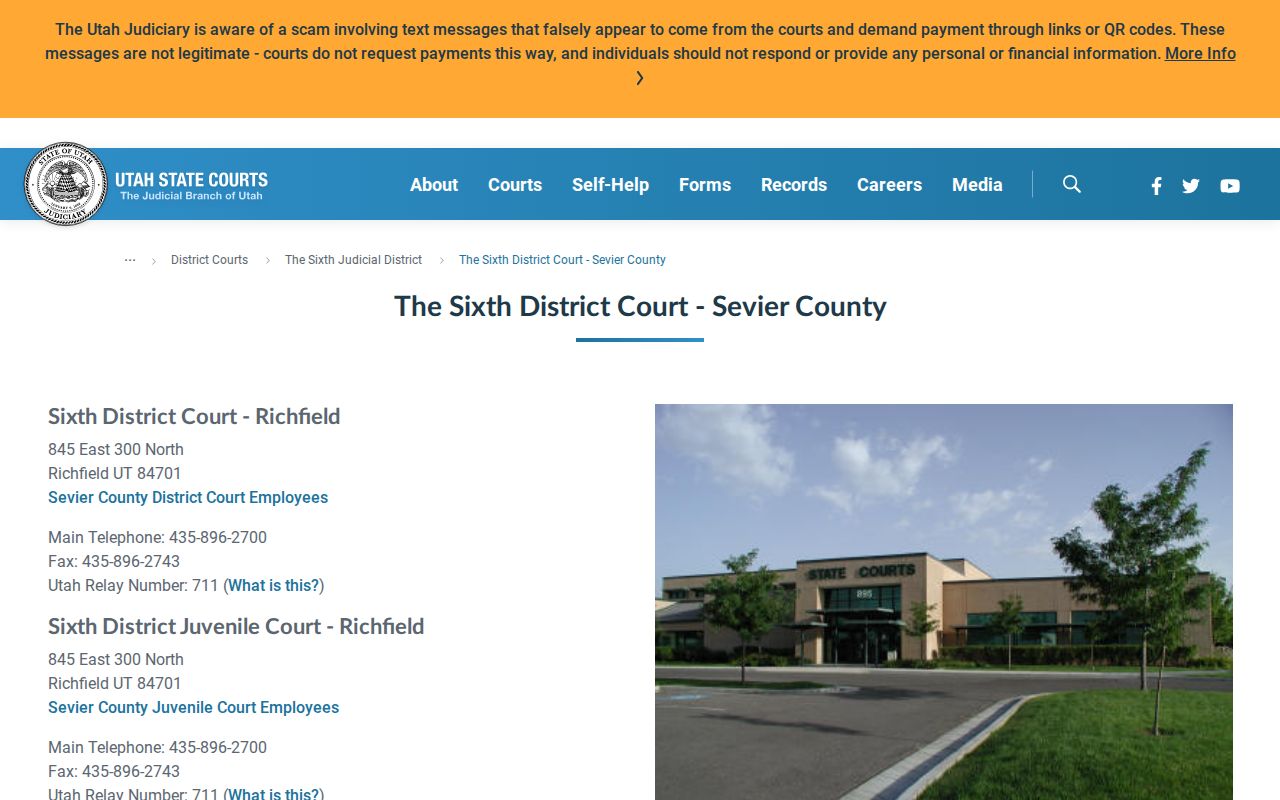
This courthouse is where readers request the filed documents that explain a felony or class A misdemeanor beyond the short online summary. Utah Relay 711 is available, and accommodation or interpreter needs should be raised with the court before a planned visit.
How to Search Case Records
Xchange: Public Case Search is Utah's statewide subscription route for public district- and justice-court summaries, and the official subscription page gives current account and price details. Sevier County searchers should first decide which court likely received the charge. A case number is the cleanest key. A person search works best when the name, court location, and filing period are all checked.
- Choose a person, business, or case-number search and select the criminal case type when the control is available.
- Enter the case number, or use the legal last name and first name for a party search.
- Narrow the result by Sixth District-Richfield or the correct justice court, then add a date range if needed.
- Open the case summary and read every count, plea, disposition, judgment, and pending hearing as a separate entry.
- Ask the proper Sevier County clerk for the exact complaint, information, plea, judgment, sentence, or certified copy needed.
| Field Label | Type | Required | Notes |
|---|---|---|---|
| Search type | Tab or radio | Yes | Person, Business, or Case Number |
| Last Name | Text | Person search | Use the legal spelling, then test known variants |
| First and Middle Name | Text | No | Useful for narrowing a common name |
| Date of Birth | Date | No | Display and use may be limited |
| Court or Location | Selector | No | Choose Richfield district or the proper justice court |
| Case Number | Text | Case mode | Use the court-assigned identifier |
| Filing-date range | Dates | No | Narrows results from a known period |
A narrow Sevier County case search reduces false matches. When the public summary is not enough, use its court and case number to request the exact signed document from the clerk.
Sevier County Case Data in Xchange
Xchange draws from CORIS rather than from an arrest log. It may show parties, counsel, the assigned judge, filed documents, hearings, judgments, and outcomes. Public district-court documents filed electronically since July 1, 2010 may be bought through the service. Converted older records often have fewer events. A scheduled hearing is only a calendar entry, not proof that the hearing happened or that the court issued a result.
The official Xchange overview describes the system's coverage, exclusions, and courthouse alternative.
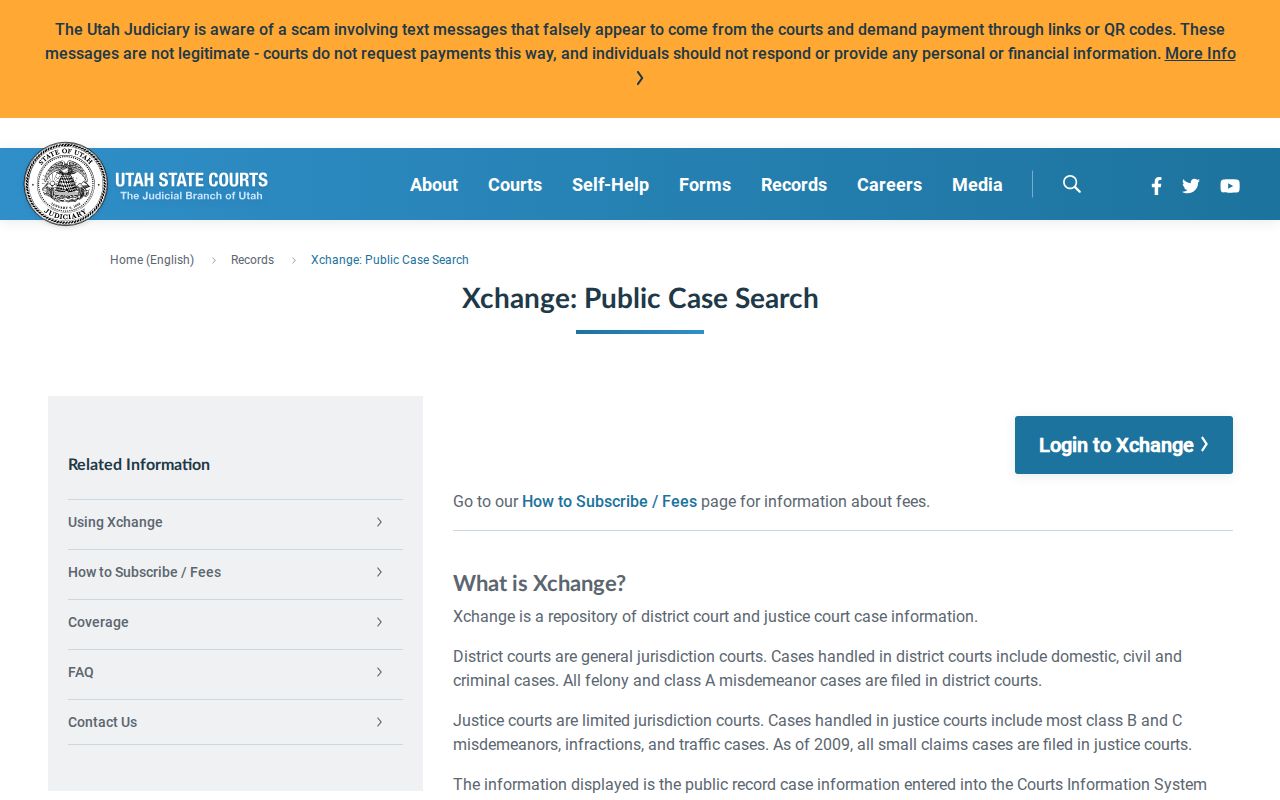
The overview helps explain why a public summary can be useful without being the full court file. Check the clerk's signed judgment when an exact result matters.
Each Sevier County criminal count needs its own reading. One count can be dismissed while another ends in a plea or verdict. The Sevier County booking label may differ from the prosecutor's information, and an amended charge can replace the first filed wording. These changes are normal parts of a case history, not proof that one source is false.
Note: A hearing date is a plan on the docket; confirm the event and outcome through a later entry or the clerk.
What the Case File Shows
A Sevier County criminal court case file centers on one prosecution. The docket is its running index, while filed documents show what parties asked the court to do and what the judge ordered. A short Xchange result can establish the court, case number, status, and disposition. The complaint or information is better for the charge as filed. The judgment and sentence are the best records for the final adjudication and court-ordered terms.
| Case Number & Court | The unique court identifier, filing location, case type, filing date, judge, and open or disposed status. |
|---|---|
| Charging Document | The complaint or prosecutor's information, including each alleged offense and statute. |
| Docket Entries | Filings, appearances, motions, orders, pleas, warrants, and closure events in date order. |
| Hearing Dates | Scheduled date, time, hearing type, and judge; calendars can change. |
| Disposition & Judgment | The outcome for each count, such as conviction, acquittal, or dismissal, and the signed ruling. |
| Sentence & Conditions | Custody, probation, fines, restitution, and other terms when entered in the public file. |
The Sevier County file can also name counsel and show financial orders. For an official payoff, certified judgment, or complete public document, use the Sevier County clerk rather than treating a portal field as the final word.
Free Sevier County Court Access
A paid Xchange account is not the only way to inspect Sevier County criminal court cases. Utah Courts identifies a public terminal at each district courthouse as the free Sevier County search fallback. The Richfield district courthouse terminal is useful when a Sevier County person search needs direct access but no subscription. The terminal may show the same public summary limits, and copies or certification can still carry a clerk fee.
The Xchange login interface shows the account gateway used for remote searches.
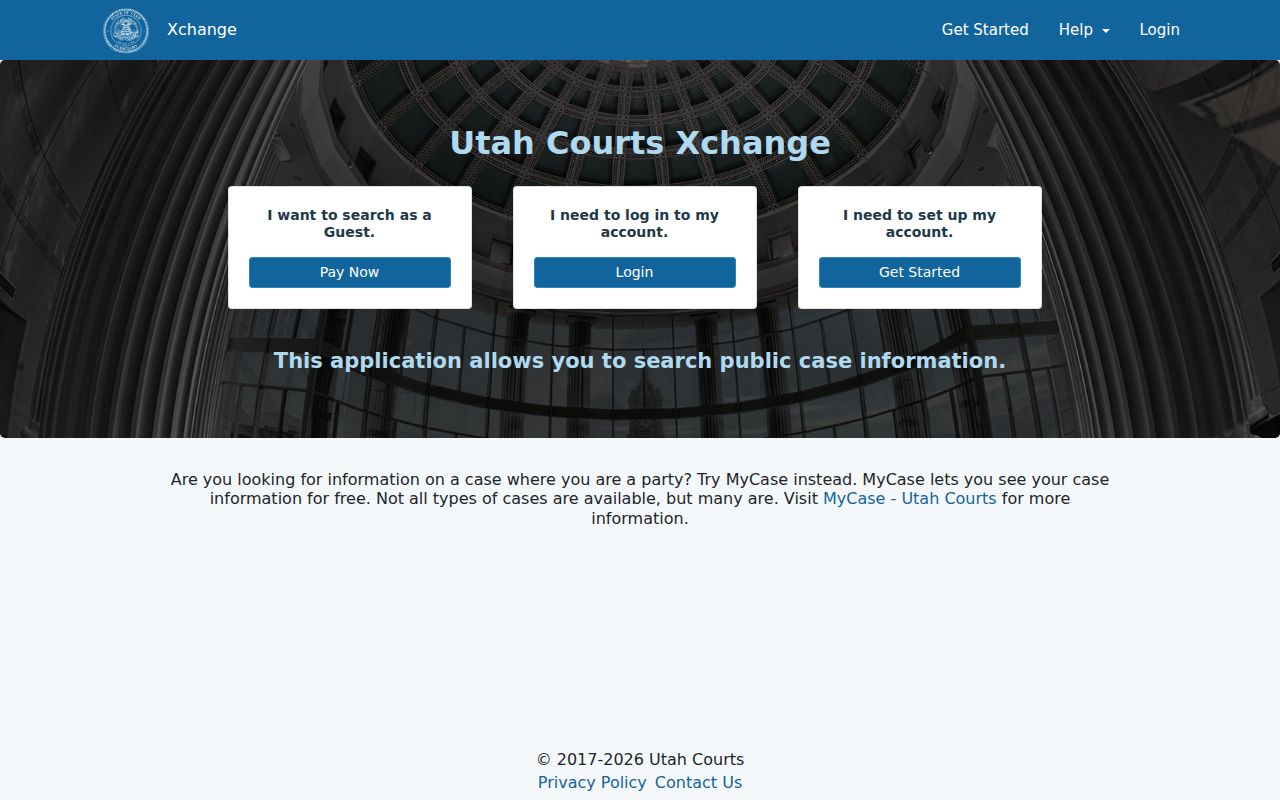
When remote access stops at the sign-in screen, use the Richfield terminal or call the court holding the file. For a known district case, ask 435-896-2700 about the current copy process. For a county justice matter, use 435-893-0461. The Utah Courts record-request instructions explain the formal route. Name the document and case number and ask about present copy and certification charges.
Stages of a Criminal Case
A Sevier County court record grows in steps. An arrest or summons may come first, but a prosecutor decides whether and what to file. The initial appearance addresses the case at an early stage. An arraignment takes up charges and plea. Discovery and motions build the pretrial docket. A plea or trial can lead to judgment and sentence. Utah's current penalty references include the felony terms in §76-3-203, misdemeanor terms in §76-3-204, and fine caps in §76-3-301.
Case flow: Charges Filed › Arraignment › Pretrial › Plea or Trial › Disposition › Sentencing
This order explains why a Sevier County booking allegation can differ from the filed count and why a current docket may show no final result. The Sevier County arrest history covers the earlier officer and jail records, while the court file tracks prosecution after filing.
Sevier County Drug Court Records
Sevier Drug Court has operated since 2000 and is described by Utah Courts as the oldest adult drug court in the Sixth District. It is a treatment-oriented track within the Sevier County court system, not a separate public case database. That history makes Richfield more than a filing counter for routine Sevier County dockets. Public access remains tied to the underlying case record and the rules that classify each filed item.
A searcher should still begin with the criminal case number and read the formal orders. Program participation does not replace the plea, judgment, sentence, or later disposition entries. Health, treatment, and other protected details should not be expected in the public view. The durable proof of what the court required is the signed public order that the clerk can provide when it is not restricted.
Older Sevier County Case Records
Thin Xchange results are common for cases converted from systems that predate full CORIS use. Most district courts were on CORIS by the end of 1998, but justice-court start dates differ. A short event list may reflect limited converted data rather than a one-step case. Public document images are also strongest for district filings made electronically from July 1, 2010 forward.
For a known old prosecution, give the court name, party name, approximate year, and any case number to the clerk. Records older than about fifty years may have moved from the active courthouse. The Utah State Archives Sixth District guide identifies historical Sevier County court series. Archives research and a current Xchange search answer different questions: the former can locate transferred files, while the latter reflects the active public court index.
Note: A sparse converted docket is not a complete event history; ask whether the clerk or Utah Archives holds the older file.
Access & Restrictions
Utah law supports public court access, but it does not open every Sevier County case record. Utah Code §78A-2-208 supplies court-record access authority, while Judicial Administration Rule 4-202.02 classifies court records. Juvenile delinquency, expunged matters, sealed filings, and protected personal data are excluded or redacted. Social Security numbers, financial accounts, victim details, medical facts, and sensitive information about minors may be withheld from the public copy.
GRAMA governs many Utah agency records, but court files follow judicial access rules and the clerk's request process. GRAMA also cannot be used to bypass the limits on BCI criminal-history dissemination. If a Sevier County criminal case does not appear, check the court and spelling first, then ask the clerk whether it is in another location, too old for a full portal entry, restricted, or expunged. A written denial should state the classification or legal basis and the available review route.