
Running a Sex Offender Check in Sevier County
The official starting point is the Utah Sex, Kidnap, and Child Abuse Offender Registry. Utah's Department of Public Safety administers it, and the public interface requires acceptance of its use terms before a search. A county filter can focus results on Sevier County. A name search is better when the person is known, while address, city, ZIP, and radius tools help with place-based awareness.
No separate public Sevier County offender list was verified. That makes the state registry the public search channel, not an unofficial directory. The Sevier County Sheriff's Office is the local point for registration instructions and questions about suspected noncompliance. A search result is a lead for careful review. Compare the profile's name, image, address, status, offense detail, and last verification rather than relying on the first matching name.
Sevier County Registry Channels
Each channel answers a different question. The Utah registry supplies the published state record. The sheriff assists with Sevier County registration and verification matters. The U.S. Department of Justice national search helps when residence, work, school, or travel may cross a state boundary. A suspected current violation should go through the registry's report function or local law enforcement, while an emergency belongs with 911.
Sevier County Sheriff's Office
835 E 300 N
Richfield, UT 84701
435-896-2600
Call for current appointment and local registration instructions.
Routine public checks should stay with the official interfaces. The sheriff's main line is not a substitute for the public database, and emergency dispatch should never be used for a routine registry question.
Searching the Utah Sex, Kidnap, and Child Abuse Offender Registry
The registry offers several ways to narrow a Sevier County search. Labels may change as the vendor updates the interface, so read the live form before entering criteria. Start broad enough to catch spelling variants, then add a city, ZIP code, county, or address when the initial result set is too wide.
- Open the official Utah registry and accept the displayed terms of use.
- Enter a name for a known person, or choose an address, city, ZIP, or Sevier County filter for an area search.
- Review the list or map and compare enough public details to avoid confusing people with similar names.
- Open the profile and read its status, address, offense, registering agency, and verification information together.
The research inventory recorded these controls without opening any private person's record:
| Field Label | Type | Required | Notes |
|---|---|---|---|
| Name | Text | No | Search by a known registrant's name. |
| Address | Text | No | Supports street or proximity searching. |
| City | Text or dropdown | No | Use Richfield, Salina, Monroe, or another locality. |
| ZIP | Text | No | Use a five-digit ZIP code. |
| County | Dropdown | No | Select Sevier for county scope. |
| Radius | Dropdown | Conditional | Use only the distances shown with an address search. |
| Map or List | View control | No | Switches the result presentation when enabled. |
Sevier County Registry Verification
Registration duties are recurring, not a one-time filing. Utah requires in-person verification during the registrant's birth month and again six months later. Changes covered by law generally must be reported within three business days. The sheriff is the local registration and verification contact for a person who lives outside another police jurisdiction in Sevier County. Call before arriving because the research did not verify public walk-in hours or an online appointment form.
Local law enforcement monitors compliance, while Utah Adult Probation and Parole has a separate role when someone is also under state supervision. Those functions should not be blended. A registry profile reports the public registration layer; it is not a probation case file and will not expose supervision notes, treatment information, or protected investigative details.
Note: Ask the sheriff for current office instructions before a Sevier County registration visit.
What a Registry Profile Shows
A public profile can combine identity, location, physical description, offense, and compliance information. Not every field appears for every person, and statutory rules control the detail made public. A careful Sevier County registry review treats the fields as a set. The legal name and aliases help with identity, while the registering agency and last verification date help explain how current the entry may be.
| Name & Aliases | Published legal name and other names tied to the registry record. |
|---|---|
| Photo & Description | Current photograph when published, plus age or birth detail, sex, race, height, weight, hair, eyes, and identifying marks as available. |
| Registered Address | Primary or secondary location at the display level allowed by Utah law. |
| Offense Information | Qualifying offense, statute, conviction place and date, and other public offense detail when available. |
| Other Public Details | Vehicles and work or school information when the statute permits publication. |
| Registration Status | Registering agency, status, and last verification information displayed by the current interface. |
A profile does not retell the full criminal case. Pleas, docket events, judgment, and sentence belong to the court file. The broader Sevier County criminal court case record is the better channel for that procedural history.
Sevier County Registry and NSOPW
Utah's registry is the best first stop for a Sevier County-focused search. The National Sex Offender Public Website, operated by the U.S. Department of Justice, adds a nationwide layer. It is useful when a person may have moved, when an address sits near a state line, or when the searcher's safety concern is not confined to Utah. NSOPW draws from participating jurisdictions, so it supplements rather than replaces the source registry.
The official NSOPW source also provided the neutral search image below. It shows the national entry point without centering any registrant.
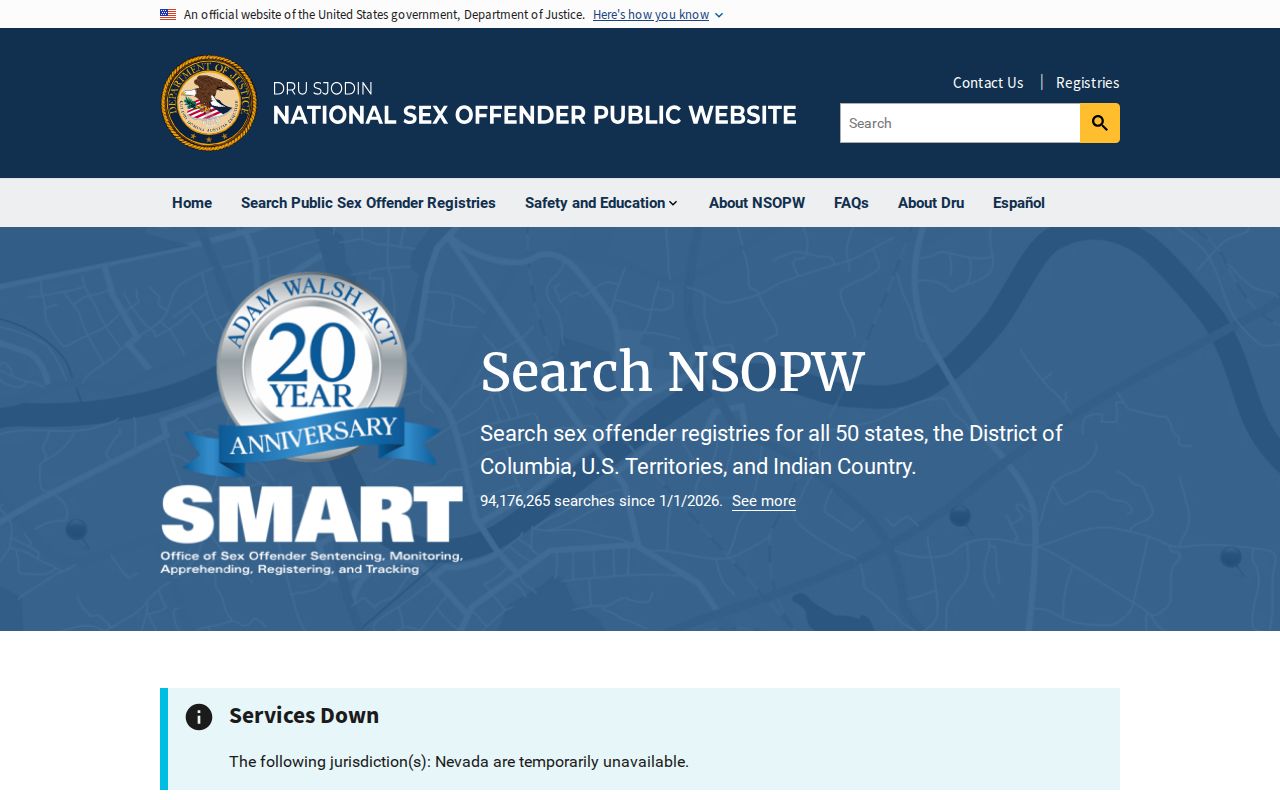
Use a national result to identify the responsible state or tribal registry, then read the originating profile and its current use terms.
Registration Requirements and Levels in Utah
Utah does not present its public categories as a simple federal Tier I, II, or III risk score. Duration turns on the qualifying offense and the current statute. The two main patterns are a period lasting through sentence or custody plus ten years, and lifetime registration for offenses listed by law. An out-of-jurisdiction registrant must follow the period required by Utah law or the controlling order after entering Utah.
| Utah Category | Duration | Verification and Changes |
|---|---|---|
| Standard registrable offense | Sentence or custody plus 10 years | In person during birth month and six months later; covered changes generally within three business days. |
| Listed lifetime offense | Life unless a removal statute applies | The same recurring verification and prompt change reporting apply. |
| Out-of-jurisdiction registrant | At least the period Utah law or an order requires | Registration is required after entry into Utah under current law. |
The exact offense and current law matter. A label alone cannot show whether a person qualifies for removal, how another jurisdiction's order applies, or what part of a record is public.
Sevier County Registry Search Gaps
An empty search is not a guarantee that no relevant history exists. A spelling difference, an address update still being processed, a move from another state, a nonpublic category, or a search filter that is too narrow can change the result. Repeat a known-person search with a verified legal spelling and aliases. For an area check, widen the place criteria and compare the Utah list with NSOPW.
If a profile appears wrong or a person may not be following current registration duties, use the official report-a-problem channel or contact the Sevier County Sheriff's Office. Do not investigate at a listed address. The public record is designed for awareness and lawful safety planning, while trained agencies handle verification and enforcement.
A recent move can also make timing important. Check the profile's registering agency and last verification field before drawing a conclusion from an address. If the entry still raises a concrete concern, give SCSO the name, published address, and reason the information may be wrong. That lets the Sevier County agency compare the public entry with the registration information it is legally allowed to review. It does not authorize a caller to demand private investigative or supervision records.
Sevier County Registry Law Update
Utah reorganized its registry authority in 2024, and the current framework now appears in Utah Code Title 53, Chapter 29 under the Department of Public Safety. Older references may still name the Department of Corrections or former Title 77, Chapter 41. Those sources can describe past administration, but they should not control a current Sevier County registry check.
This change affects where readers verify duties, duration, removal rules, and agency authority. The live DPS registry and the current code are the primary sources. Adult Probation and Parole still supervises people who are on probation or parole, but supervision does not make UDC the registry administrator.
The current chapter also matters when old search results, saved instructions, or secondary references conflict with the live source. For a Sevier County registry question, check the date of the material and follow the present DPS link. Statutory duties can depend on the offense, sentence, entry into Utah, and a court order. General category summaries cannot resolve an individual duty or removal question.
Lawful Use and Community Notification
Public registry information supports personal, family, and community safety. Use it to understand published locations, verify a known profile, or plan a lawful safety conversation. Suspected noncompliance belongs with the registry's reporting route or the Sevier County Sheriff's Office. A present threat or emergency belongs with 911.
Use registry information lawfully: Utah Code Title 53, Chapter 29 governs registry publication and enforcement. Misusing registry data to harass, threaten, intimidate, trespass, or support vigilantism is a crime and can cause harm to registrants, households, and bystanders.
Public access does not authorize private enforcement. Confirm dates and addresses through the official record, respect the disclaimer shown before search, and send factual concerns to the agency responsible for compliance.